Guydosh's
Report on
The SUNY University Faculty Senate
Spring 2002 Meeting
To: The Plattsburgh State
University Community
From: Ray Guydosh
Date: April 21, 2002
Subject: SUNY University Faculty Senate Meeting
I recently represented our Plattsburgh campus at the Spring plenary meeting of the University Faculty Senate in Alfred, NY. The University Senate was created to represent the voice of SUNY Faculty state-wide. It is composed of faculty representatives from each of the State University campuses and is organized much as our own local Faculty Senate.
Much of the business of the meeting centered around two issues: a proposal by a private vendor to develop an internet based course in American History to satisfy the SUNY-wide general education requirement, and the recent comments of Trustee Candace deRussy concerning Black Studies programs.
The Global Education Network recently impressed
SUNY administration with demonstrations of an internet based American History
course. The firm was then given access to SUNY communication facilities
(including email) to
recruit faculty to assist in developing modules for the course. University
Senators objected on two major grounds. First, the project violated the
principle of allowing campuses to develop their own general education
courses. There was fear that this was but another step in standardizing
General Education across the system, and in particular using a methodology which
would remove the course from control
of local campuses.  Second, University Senators were greatly concerned
about using an outside vendor to develop such a course and giving that one
particular vendor preferential access to the SUNY communication system to
recruit
developers. (You may not have seen the email from this
vendor,
since it was not widely available on our campus. But you can see
a copy on my web site.) In his talk with
the University Faculty Senate, Provost Salins was vigorously attacked for his
encouragement of this American History Pilot Project. Eventually, he
agreed to suspend all participation by SUNY in the project. He requested
in return that the Senate not pass a formal resolution attacking his initial
participation.
Second, University Senators were greatly concerned
about using an outside vendor to develop such a course and giving that one
particular vendor preferential access to the SUNY communication system to
recruit
developers. (You may not have seen the email from this
vendor,
since it was not widely available on our campus. But you can see
a copy on my web site.) In his talk with
the University Faculty Senate, Provost Salins was vigorously attacked for his
encouragement of this American History Pilot Project. Eventually, he
agreed to suspend all participation by SUNY in the project. He requested
in return that the Senate not pass a formal resolution attacking his initial
participation.
Senators were equally concerned about
recent comments made by Trustee Candace deRussy concerning the academic value
and rigor of Black Studies programs in SUNY. 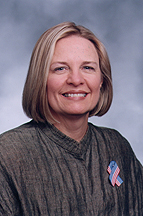 Among two campuses which she
singled out for attack, one did not actually have a Black Studies program, which
did little to demonstrate her credibility. The University Senate charged
its President to communicate with the Board of Trustees, collectively and
individually, decrying Trustee deRussy's comments. The Senate
pointed out in a draft of a letter "that it is in the interests of the
State University that its programs be presented by all the University's
constituent parts honestly, thoughtfully and accurately, that a trustee when
making public statements should indicate clearly whether he or she is speaking
as a private individual or as a representative of the Board..., and that a
trustee who believes that there is an issue in SUNY that should be considered,
should do so in a collaborative and constructive fashion together with fellow
trustees, administration, and faculty."
Among two campuses which she
singled out for attack, one did not actually have a Black Studies program, which
did little to demonstrate her credibility. The University Senate charged
its President to communicate with the Board of Trustees, collectively and
individually, decrying Trustee deRussy's comments. The Senate
pointed out in a draft of a letter "that it is in the interests of the
State University that its programs be presented by all the University's
constituent parts honestly, thoughtfully and accurately, that a trustee when
making public statements should indicate clearly whether he or she is speaking
as a private individual or as a representative of the Board..., and that a
trustee who believes that there is an issue in SUNY that should be considered,
should do so in a collaborative and constructive fashion together with fellow
trustees, administration, and faculty."
During his visit with the University Senate,
Chancellor Robert King again reviewed his ten strategies for advancing SUNY,
about which I reported to you several months ago. And he spoke again at considerable
length about several of those strategies. Being system wide strategies,
none of them seemed to have any immediate impact on our own campus.
However, I will share some details with particular faculty who might have
interests in some of them. The Chancellor also mentioned the removal of
two top officials from the SUNY construction fund for their apparent
participation in a plan to award contracts to a friend of the Governor.
During questioning, the Senate again vigorously attacked the Global Education
Network plan for a system-wide internet-based American History course. The
Chancellor was on the verge of requesting the Provost to cease involvement when
he was informed by Vice-Provost Don Steven that the Provost had already agreed
to do so.
again reviewed his ten strategies for advancing SUNY,
about which I reported to you several months ago. And he spoke again at considerable
length about several of those strategies. Being system wide strategies,
none of them seemed to have any immediate impact on our own campus.
However, I will share some details with particular faculty who might have
interests in some of them. The Chancellor also mentioned the removal of
two top officials from the SUNY construction fund for their apparent
participation in a plan to award contracts to a friend of the Governor.
During questioning, the Senate again vigorously attacked the Global Education
Network plan for a system-wide internet-based American History course. The
Chancellor was on the verge of requesting the Provost to cease involvement when
he was informed by Vice-Provost Don Steven that the Provost had already agreed
to do so.
In internal business, James McEwaine, a musician from Purchase, was chosen to replace Richard Collier of Albany as the Vice-President and Secretary of the University Faculty Senate. The Comprehensive College Sector chose me to be their chair for a second year. Senators from various sectors typically meet during the University Faculty Senate meetings to consider concerns related to their sectors to forward to the University Senate and to the Chancellor. My web site includes a report on the issues considered by the Comprehensive College Sector.
 As usual, these are all my own perceptions; other folks may have seen things
differently. Likewise, as I have said in other reports to you, I appreciate your confidence in choosing me to represent the Plattsburgh campus as your representative to the University Senate.
And if I haven't talked with you otherwise, I would be pleased to provide you with more
detail about any of the items in this report.
As usual, these are all my own perceptions; other folks may have seen things
differently. Likewise, as I have said in other reports to you, I appreciate your confidence in choosing me to represent the Plattsburgh campus as your representative to the University Senate.
And if I haven't talked with you otherwise, I would be pleased to provide you with more
detail about any of the items in this report.
|
STOP |
This page, all of its parts
(including Amite photo), and all linked
material residing on this web site
|